


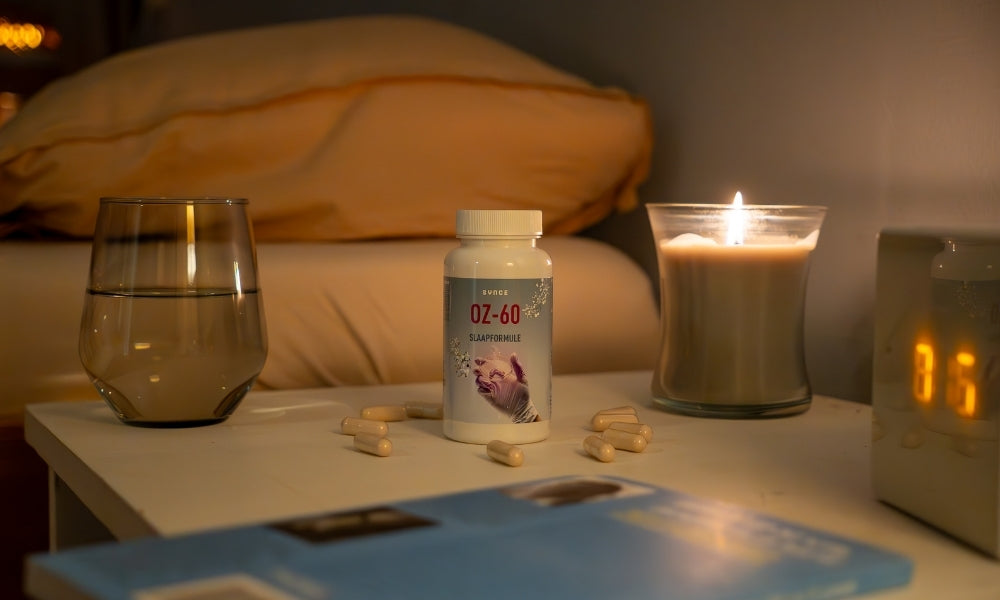
Saffron extract is an oral supplement made from the stigmas, the red threads, of the Crocus sativus flower. Research typically focuses not on saffron as a cooking spice, but on a standardized extract in capsule or tablet form with a controlled daily dosage. This distinction is important because scientific results refer to this standardized form and not automatically to saffron in food.
What is saffron extract?
In clinical literature, saffron extract is typically described as a standardized preparation from the plant material of Crocus sativus. In RCTs and reviews, substances such as crocin, crocetin, picrocrocin, and safranal are often mentioned, primarily to indicate the composition and plausibility of the extract. At the same time, the practical core remains simple: it is a measurably dosed supplement, usually in milligrams per day. Many studies use 28 to 30 mg per day, although dosages vary more widely in some areas.
This immediately clarifies why saffron extract is not the same as “using a little saffron in food.” In studies, extracts are standardized to keep their composition as constant as possible. This makes the outcomes more comparable and also more specific: they say something about saffron extract as a supplement, not about arbitrary amounts of saffron from food.
Is saffron extract healthy?
Whether saffron extract is “healthy” depends on which outcome you mean. Based on multiple studies, the strongest and most consistent signal is in the domain of mood. A large systematic review and meta-analysis of 23 RCTs reported clear effects compared to placebo on depressive and anxiety symptoms, but the authors also noted publication bias and limited regional distribution of studies as important nuances. More recent RCTs in subclinical populations show small to moderate effects, along with a clear placebo response. So, the evidence is positive, but not without caveats.
For sleep, the picture is also favorable, but narrower. Meta-analyses show improvements in outcomes such as PSQI and ISI, and a recent RCT in older adults with sleep complaints found improvements in both subjective and objective sleep measures. However, the total body of evidence is smaller than for mood. So, the effect seems promising, but the basis is less broad.
For broader health effects, such as cardiometabolic markers, the evidence is more mixed. While statistically significant changes have been found in meta-analyses for fasting glucose, HbA1c, and HOMA-IR, for example, the results are often heterogeneous. This means that studies differ considerably from each other, requiring caution with broad conclusions. For cognition, there are signals, but these are based on few trials and small numbers of participants.

What does saffron do in your body?
In human RCTs, saffron extract is primarily evaluated using outcome measures such as symptom scales, sleep questionnaires, biomarkers, and in some cases, objective sleep measurements. Research shows that saffron supplementation increased urinary crocetin concentration, and this change was associated with a change in depression score. This demonstrates that saffron metabolites can be systemically available, although it does not immediately prove which mechanism is precisely decisive.
Based on multiple studies, saffron extract appears to primarily act in domains such as mood and sleep. In a stressor paradigm, saffron extract was observed to attenuate the decrease in HRV during stress. For sleep, improvements are seen in subjective scales, and in a recent pilot-RCT, also in objective measures such as sleep latency and wake time during the night. For cardiometabolic outcomes and cognition, there are signals, but the evidence is less robust or more heterogeneous.
Are there any side effects of saffron extract?
Safety data from the studies primarily indicate mild side effects and few to no serious adverse events within the studied durations. In an 8-week RCT in healthy adults with subclinical symptoms, adverse events were reported equally in both groups, with no serious events and no dropouts due to side effects. However, there were more gastrointestinal complaints in the saffron arm. In other RCTs and reviews, serious side effects are usually not reported, but there too, most studies are short-term, often 4 to 12 weeks.
This means that short-term safety appears reasonably reassuring, but based on studies, it is limited to say what happens with rare or long-term effects. In studies with cognitive indications, such as Alzheimer's or MCI, mild symptoms such as dizziness, dry mouth, fatigue, and nausea occurred in both intervention and control groups. So, the general picture remains: usually mild, but not the same as completely without risk.
What are important characteristics and effects?
One of the most striking features is that many RCTs on psychological outcomes use a relatively narrow dosage range. Several studies use approximately 28 to 30 mg per day, with interventions lasting 4 to 12 weeks. For sleep, dosages vary more widely, partly because some trials use saffron extract and others use saffron components. A meta-analysis mentions 100 mg per day as an appropriate dose in a subgroup analysis, while other studies with 30 mg per day also show improvements. This makes it clear that dosage cannot be separated from extract type, standardization, and population.
A second important characteristic is that effects seem particularly clear where baseline complaints are already present. In subclinical or clinical symptoms, improvements are more often seen than in fully healthy populations without clear complaints. In addition, standardization plays a major role. Because saffron is an expensive raw material, studies explicitly mention that adulteration is a real concern. Therefore, different extracts are not automatically equivalent. This is important when interpreting studies and when comparing results.
Conclusion: what is saffron extract?
Saffron extract is a standardized supplement derived from the stigmas of Crocus sativus, typically dosed in fixed daily amounts. Based on the provided RCTs and meta-analyses, the strongest evidence is for mood, with a smaller but positive signal for sleep. For cardiometabolic effects and cognition, there are indications, but these are more heterogeneous or based on few trials. Saffratonine is not an established scientific term within this human literature. Side effects of saffron extract in the studies examined typically appear mild, but most trials are short-term, limiting long-term certainty.
References
Ayati, Z., Yang, G., Ayati, M. H., Emami, S. A., & Chang, D. (2020). Saffron for mild cognitive impairment and dementia: A systematic review and meta-analysis of randomised clinical trials. BMC Complementary Medicine and Therapies, 20, 333. doi:10.1186/s12906-020-03102-3. Link
Hausenblas, H. A., Heekin, K., Mutchie, H. L., & Anton, S. D. (2015). A systematic review of randomized controlled trials examining the effectiveness of saffron (Crocus sativus L.) on psychological and behavioral outcomes. Journal of Integrative Medicine, 13(4), 231–240. doi:10.1016/S2095-4964(15)60176-5. Link
Jackson, P. A., Forster, J., Khan, J., Pouchieu, C., Dubreuil, S., Gaudout, D., … Kennedy, D. O. (2021). Effects of saffron extract supplementation on mood, well-being, and response to a psychosocial stressor in healthy adults: A randomized, double-blind, parallel group, clinical trial. Frontiers in Nutrition, 7, 606124. doi:10.3389/fnut.2020.606124. Link
Kell, G., Rao, A., Beccaria, G., Clayton, P., Inarejos-García, A. M., & Prodanov, M. (2017). Affron® a novel saffron extract (Crocus sativus L.) improves mood in healthy adults over 4 weeks in a double-blind, parallel, randomized, placebo-controlled clinical trial. Complementary Therapies in Medicine, 33, 58–64. doi:10.1016/j.ctim.2017.06.001. Link
Lang, S., et al. (2025). A standardised saffron extract improves subjective and objective sleep quality in healthy older adults with sleep complaints: Results from a randomised, placebo-controlled pilot study. Food & Function. doi:10.1039/D5FO00917K. Link
Lian, J., Zhong, Y., Li, H., Yang, S., Wang, J., Li, X., … Chen, G. (2022). Effects of saffron supplementation on improving sleep quality: A meta-analysis of randomized controlled trials. Sleep Medicine, 93, 196–203. doi:10.1016/j.sleep.2022.03.001. Link
Lopresti, A. L., Drummond, P. D., Inarejos-Garcia, A. M., & Prodanov, M. (2018). A standardised extract from saffron (Crocus sativus L.) for the treatment of youth anxiety and depressive symptoms: A randomised, double-blind, placebo-controlled study. Journal of Affective Disorders, 232, 349–357. doi:10.1016/j.jad.2018.02.070. Link
Lopresti, A. L., Smith, S. J., Marx, W., Díez-Municio, M., & Morán-Valero, M. I. (2025). An examination into the effects of a saffron extract on mood and general wellbeing in adults experiencing low mood: A randomized, double-blind, placebo-controlled trial. The Journal of Nutrition, 155(7), 2300–2311. doi:10.1016/j.tjnut.2025.05.024. Link
Marx, W., Lane, M., Rocks, T., Ruusunen, A., Loughman, A., Lopresti, A., … Dean, O. M. (2019). Effect of saffron supplementation on symptoms of depression and anxiety: A systematic review and meta-analysis. Nutrition Reviews, 77(8), 557–571. doi:10.1093/nutrit/nuz023. Link
Mohammadi, M. M., & Karimi, Z. (2026). Effect of saffron on premenstrual syndrome and dysmenorrhea: A systematic review and meta-analysis. Korean Journal of Family Medicine, 47(1), 69–80. doi:10.4082/kjfm.24.0259. Link
Rafiei, S. K. S., et al. (2023). Saffron and sleep quality: A systematic review of randomized controlled trials. Nutrition and Metabolic Insights, 16, 11786388231160317. doi:10.1177/11786388231160317. Link
Zamani, M., Zarei, M., Nikbaf-Shandiz, M., Gholami, F., Hosseini, A. M., Nadery, M., et al. (2022). The effects of saffron supplementation on cardiovascular risk factors in adults: A systematic review and dose-response meta-analysis. Frontiers in Nutrition, 9, 1055517. doi:10.3389/fnut.2022.1055517. Link


