


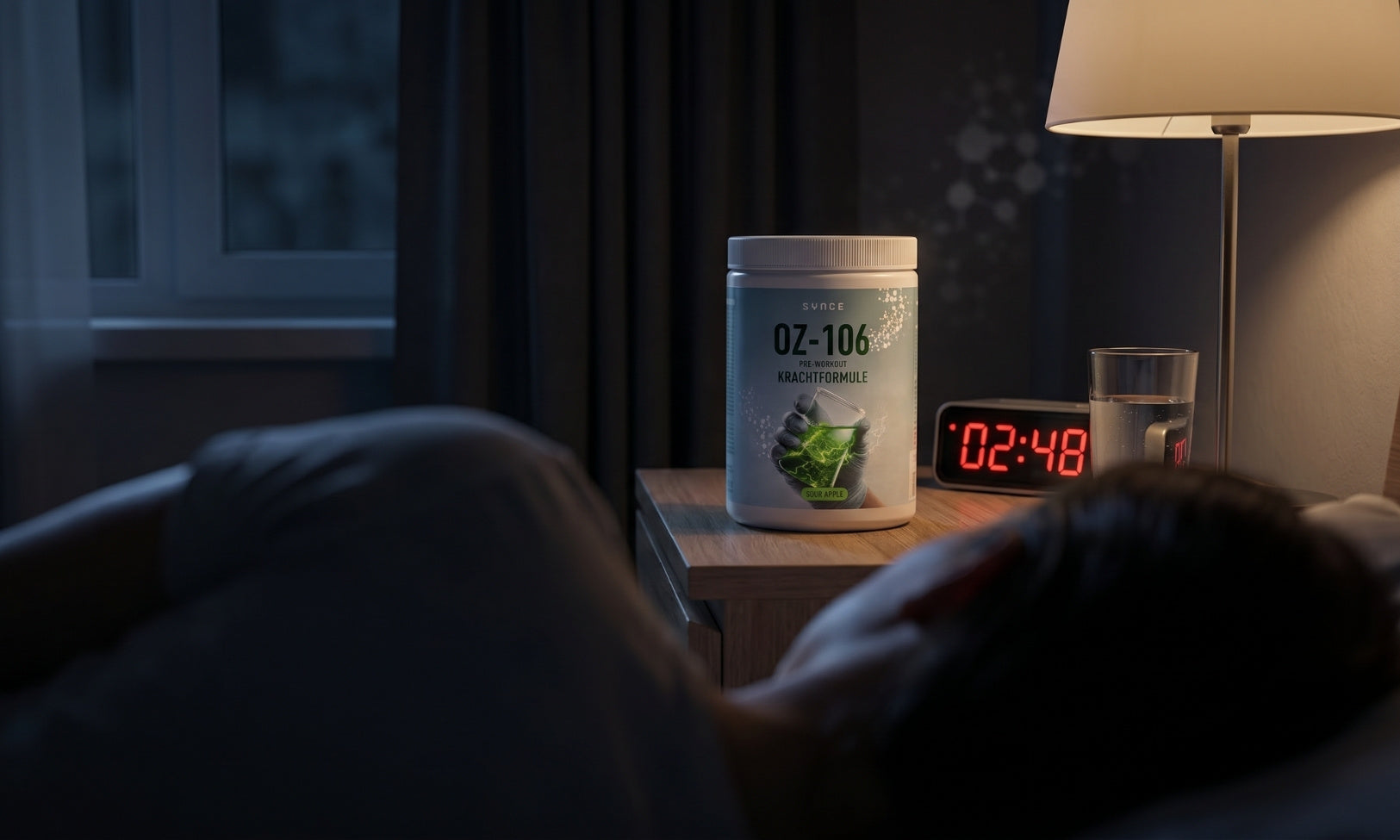
If your pre-workout contains caffeine, research shows that you need to take it well in advance. For a normal dosage, it seems advisable to think more about 12 to 13 hours before bedtime than 4 to 6 hours, although this also depends on the dose and how sensitive you are to caffeine. The most important difference here is not so much in the word pre-workout, but in whether it contains caffeine. For caffeine-free pre-workout, the evidence is much more limited, as there have been hardly any direct sleep studies on it. In this blog, you can read all about how long before bedtime you should take your pre-workout (Gardiner et al., 2023; Gardiner et al., 2025).
How long before bedtime should you take pre-workout?
The main conclusion from the research is quite clear: the more caffeine you consume and the closer to bedtime you do it, the greater the chance of poorer sleep. In a large analysis of experimental studies, total sleep time decreased by an average of 45 minutes, sleep efficiency declined, and it took longer to fall asleep. Based on this, it was estimated that a standard serving of pre-workout with approximately 217.5 mg of caffeine should ideally be taken about 13.2 hours before bedtime to prevent loss of sleep time (Gardiner et al., 2023).
A newer study clarifies that dose really matters. No clear sleep loss was observed with 100 mg of caffeine up to 4 hours before bedtime, but 400 mg disrupted sleep within 12 hours before bedtime. This means that a light dosage is sometimes less problematic, but a regular caffeine-containing pre-workout in the evening quickly becomes unfavorable for your sleep (Gardiner et al., 2025).
What is pre-workout?
Pre-workout is a collective term for supplements you take before training to make your workout feel sharper or more intense. It usually involves a mix of ingredients, such as caffeine, beta-alanine, citrulline, creatine, tyrosine, and other substances related to energy, focus, or pump. For sleep, caffeine is particularly important, as this ingredient consistently emerges in research as the main cause of sleep disturbance (Gardiner et al., 2023; Chang et al., 2025).
Therefore, when it comes to sleep, you should always differentiate between two types of pre-workout: with caffeine and without caffeine. This distinction is much more important than the name on the label. A caffeine-containing formula like SYNCE Power Formula therefore requires a different consideration than a caffeine-free formula like SYNCE Pump Formula.


Pre-workout with caffeine before sleep
For pre-workout with caffeine, the evidence is strongest. Multiple studies show the same pattern: less total sleep time, less deep sleep, longer time to fall asleep, and lower sleep quality. In a meta-analysis of controlled studies, total sleep time decreased by an average of more than 34 minutes, and time to fall asleep increased by more than 8 minutes. Deep sleep also decreased, which is important for recovery (Chang et al., 2025).
Even if you are used to caffeine, that does not automatically mean your sleep is no longer affected. In a study of regular caffeine users, REM sleep continued to shift and waking up felt less good, despite daily use. In other words: drinking a lot of coffee during the day does not automatically mean that a pre-workout in the evening no longer has an effect (Weibel et al., 2021).
Among athletes, it is also observed that objective sleep measurements sometimes deteriorate less severely than perceived, but subjective sleep quality often clearly worsens. This was seen, for example, in judokas and rowers who took caffeine in the evening before training or performance. Especially higher doses of 6 to 9 mg per kg of body weight showed a clear deterioration in sleep quality and sleepiness the next day (Filip-Stachnik, 2022; Karakulak et al., 2025).

Caffeine-free pre-workout before sleep
For caffeine-free pre-workout, the picture is less clear, not because it has been proven to have no effect, but because almost no direct sleep studies have been conducted on it. The most useful study compared a caffeinated and a non-caffeinated pre-workout with placebo. It showed that both formulas could influence some performance outcomes, but sleep was not measured in that study (Stratton et al., 2022).
This means that for non-stim products, you need to formulate more carefully. Based on the research, you cannot firmly say that a caffeine-free pre-workout right before sleep has no effect. What you can say is that the known sleep risk in this literature is mainly linked to caffeine. Therefore, it makes sense that a caffeine-free formula, such as SYNCE Pump Formula, is more logical for late training than a caffeine-containing pre-workout, but direct sleep data for this are still limited (Stratton et al., 2022).
Conclusion: how long before sleep should you take pre-workout?
The most sober conclusion is that the answer mainly depends on caffeine. If your pre-workout contains caffeine, then research shows that for a normal dosage, you should think more in terms of 12 to 13 hours before bedtime than a short margin of a few hours. Lower dosages can sometimes be less disruptive, but higher dosages continue to have a long-term impact on sleep quality, sleep latency, and total sleep time (Gardiner et al., 2023; Gardiner et al., 2025).
For caffeine-free pre-workout, the evidence is more limited. There is currently too little direct sleep research to provide a strict time limit. What is strongly substantiated, however, is that the sleep risk in the literature is mainly associated with caffeine and much less with the rest of the pre-workout category (Stratton et al., 2022).
Frequently asked questions about pre-workout before sleep
How many hours before sleep should you stop taking pre-workout?
If your pre-workout contains caffeine, a generous margin is advisable. Research indicates that a normal portion with approximately 217.5 mg of caffeine should ideally be taken around 13 hours before bedtime to avoid shortening sleep time. For lower doses, this margin may sometimes be smaller, but it varies per person (Gardiner et al., 2023; Gardiner et al., 2025).
Can you take caffeine-free pre-workout better if you train late?
Technically you can, but it is usually not a good choice if you want to sleep well that same night. Especially with medium to high doses, research clearly shows poorer sleep quality, less deep sleep, and more difficulty falling asleep (Chang et al., 2025; Karakulak et al., 2025).
Is caffeine-free pre-workout better if you train late?
Based on current research, that seems to be the case. The direct sleep risk in the literature is primarily associated with caffeine. For non-stim pre-workouts, there are fewer sleep studies, but precisely for this reason, a caffeine-free formula is more logical when you want to train late in the day (Stratton et al., 2022).
References
Chang, Y.-H., Cheng, Y.-C., & Cheng, W.-J. (2025). Age- and dose-specific effects of caffeine on sleep: A meta-analysis of controlled crossover trials. Sleep Medicine, 136, 106874. Click here
Filip-Stachnik, A. (2022). Does acute caffeine intake before evening training sessions impact sleep quality and recovery-stress state? Applied Sciences, 12(19), 9957. Click here
Gardiner, C., Weakley, J., Burke, L. M., Roach, G. D., Sargent, C., Maniar, N., Townshend, A., & Halson, S. L. (2023). The effect of caffeine on subsequent sleep: A systematic review and meta-analysis. Sleep Medicine Reviews, 69, 101764. Click here
Gardiner, C. L., Weakley, J., Burke, L. M., Fernandez, F., Johnston, R. D., Leota, J., Russell, S., Munteanu, G., Townshend, A., & Halson, S. L. (2025). Dose and timing effects of caffeine on subsequent sleep: A randomized clinical crossover trial. Sleep, 48(4), zsae230. Click here
Karakulak, I., Yildirim, U. C., Erkan, D., Karayigit, R., Eyuboglu, E., Diedhiou, A. B., Gundem, M. C., Tuncer, S. Y., Sar, H., Ozen, G., & Akca, F. (2025). Varying doses of evening caffeine ingestion have different effects on rowing ergometer performance, sleep quality, and wakefulness scores. Frontiers in Nutrition, 12, 1659220. Click here
Robillard, R., Bouchard, M., Cartier, A., Nicolau, L., & Carrier, J. (2015). Sleep is more sensitive to high doses of caffeine in the middle years of life. Journal of Psychopharmacology, 29(6), 688–697. Click here
Stratton, M. T., Siedler, M. R., Harty, P. S., Rodriguez, C., Boykin, J. R., Green, J. J., Keith, D. S., White, S. J., DeHaven, B., Williams, A. D., & Tinsley, G. M. (2022). The influence of caffeinated and non-caffeinated multi-ingredient pre-workout supplements on resistance exercise performance and subjective outcomes. Journal of the International Society of Sports Nutrition, 19(1), 126–149. Click here
Weibel, J., Lin, Y.-S., Landolt, H.-P., Berthomier, C., Brandewinder, M., Kistler, J., Rehm, S., Rentsch, K. M., Meyer, M., Borgwardt, S., Cajochen, C., & Reichert, C. F. (2021). Regular caffeine intake delays REM sleep promotion and attenuates sleep quality in healthy men. Journal of Biological Rhythms, 36(4), 384–394. Click here


