


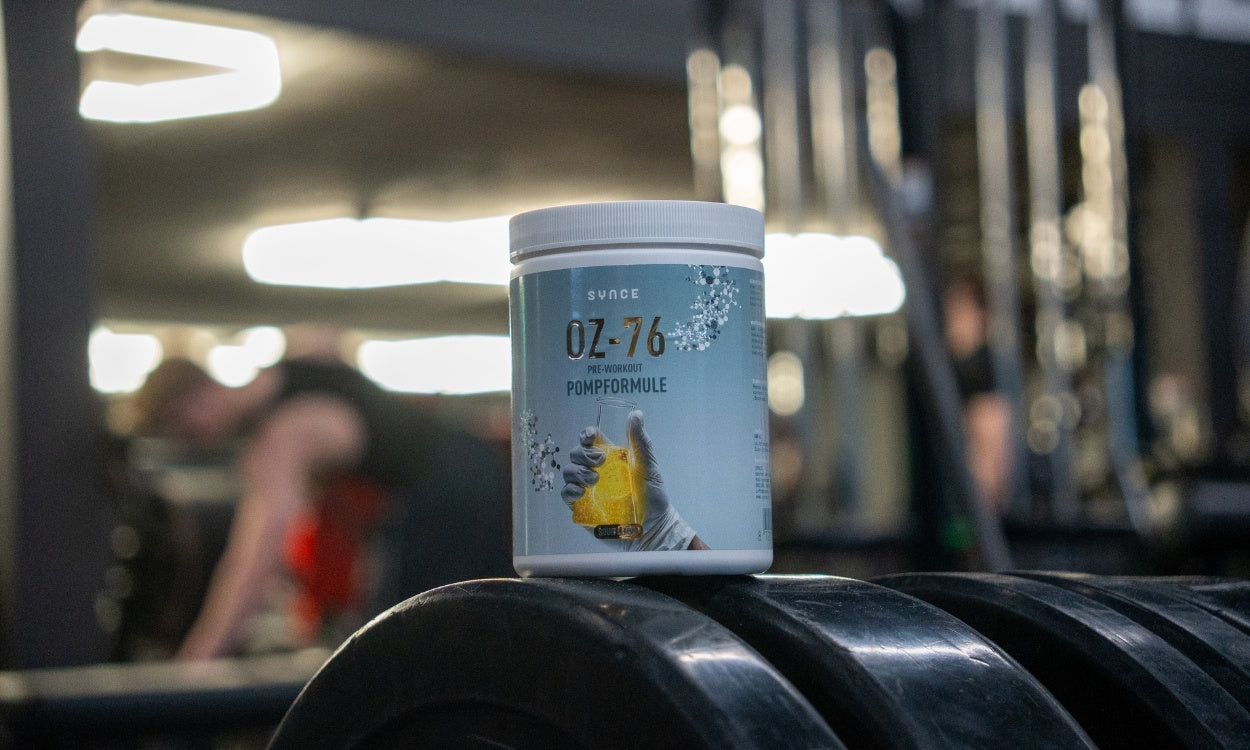
Pompformule pre-workout is a caffeine-free pre-workout for athletes who train for pump, focus, and training output, but consciously want to train without caffeine. The formula was developed based on more than 76 scientific studies and contains 17 ingredients per 22-gram dose. These include L-citrulline, beta-alanine, glycerol monostearate, malic acid, betaine, electrolytes, Panax ginseng, vitamins, and black pepper extract. The composition is intended for athletes who train late, are sensitive to caffeine, or are looking for a pre-workout without stimulants. The core is transparent: you see what you're taking, how much you're taking, and why each ingredient has a place within the formula. The product composition and positioning are derived from the provided Pompformule information.
What is the Pompformule pre-workout?
Pompformule is a pre-workout without caffeine. This makes the formula different from many classic pre-workouts, where the effect often relies heavily on stimulants. Pompformule, on the other hand, is built around ingredients that support pump, fluid balance, intensive exertion, and focus without caffeine.
Per 22 grams, Pompformule contains 6000 mg L-citrulline, 3500 mg beta-alanine, 3500 mg glycerol monostearate, 2400 mg malic acid, 2000 mg betaine anhydrous, 250 mg potassium, 250 mg sea salt, 50 mg magnesium, 20 mg calcium, 200 mg Panax ginseng, vitamin C, B-vitamins, and 5 mg black pepper extract.
Many studies focus on individual ingredients. This should be honestly stated. The strength of Pompformule therefore lies not in the claim that the exact complete formula has been studied one-to-one, but in the translation of ingredient data into a complete caffeine-free formula with logical dosages and combinations.
Why is a caffeine-free pre-workout important?
Not every athlete wants to use caffeine. Some athletes are sensitive to caffeine, experience restlessness from it, or train later in the day. In the latter case, caffeine can be detrimental to sleep, and sleep is crucial for recovery and training adaptation.
A caffeine-free pre-workout can then be a practical choice. You opt not for a strong stimulant, but for ingredients that support blood flow, fluid balance, intensive exertion, and the training sensation. Caffeine-free therefore does not mean that there are no active ingredients. It means that the formula is built without stimulants.
Pompformule is therefore particularly suitable for athletes who take their training seriously but do not want to be dependent on caffeine. This is especially relevant for evening workouts.
Why is scientifically backed pre-workout important?
Many pre-workouts are judged by taste, tingling, or how "hard" they hit. However, this says little about the quality of the formula. A scientifically backed pre-workout starts with different questions: which ingredients have been studied, which dosages are logical, and which processes do you want to support during training?
Pompformule is supported by OZ-76. This refers to more than 76 scientific sources that were considered in the development of the formula. This is not a magical seal of approval and no guarantee of a specific result. It is primarily a transparent way to show that the formula was not put together randomly.
Nuance remains important here as well. Not every ingredient has been equally strongly researched. For some ingredients, the evidence is stronger, such as citrulline and beta-alanine. For other ingredients, the substantiation is more supportive or indirect. This is consistent with an honest formula: every ingredient must have a clear reason, but not every ingredient needs to play the same leading role.

Pump and blood flow: citrulline, glycerol, and electrolytes
L-citrulline is one of the most important ingredients in Pompformule. Citrulline can increase the availability of arginine, which in turn is involved in nitric oxide. Nitric oxide plays a role in vasodilation and blood flow during exercise (Schwedhelm et al., 2008).
In strength training, the combination of blood flow, training volume, and local muscle stimulation is particularly relevant. A systematic review and meta-analysis of citrulline malate in strength training shows that acute supplementation in some studies can support repetition performance, but that the effects remain dependent on protocol, training experience, and exercise choice (Vårvik et al., 2021). A meta-analysis of citrulline also found possible effects on perceived exertion, muscle soreness, and lactate levels after exercise (Rhim et al., 2020).
Glycerol monostearate has been added due to its relationship with fluid balance. Glycerol is primarily studied in the context of hyperhydration: retaining extra fluid during exercise. A meta-analysis showed that glycerol-induced hyperhydration can increase fluid retention, although this has mainly been studied in endurance and heat contexts (Goulet et al., 2007). Later research showed that the combination of salt and glycerol can lead to more fluid retention than salt or glycerol alone (Goulet et al., 2018).
Therefore, the combination with sea salt, potassium, magnesium, and calcium is logical. These electrolytes play a role in fluid balance, muscle function, and nerve impulse transmission. Pump is not just a feeling; it is related to blood flow, fluid, electrolytes, and the training stimulus. At the same time, pump is not automatically the same as muscle growth.
Training output: beta-alanine, betaine, and malate
Beta-alanine is included at 3500 mg. This ingredient is mainly linked to carnosine in the muscle. Carnosine helps buffer acidification during intensive exertion. This makes beta-alanine particularly relevant for repeated efforts where acidification and fatigue play a role.
A large meta-analysis shows that beta-alanine can improve exercise capacity, especially in exercises where acidification is involved (Saunders et al., 2017). A more recent systematic review and meta-analysis in trained young men also found that beta-alanine can be relevant for maximal intensive exercise, although effects remain dependent on sport type, duration, and training level (Georgiou et al., 2024).
Betaine anhydrous is included at 2000 mg. Research on betaine is more mixed than for beta-alanine, but there are interesting signals. A recent systematic review and meta-analysis concluded that chronic betaine supplementation can influence certain performance outcomes, especially in contexts of strength, power, or repeated exertion (Zawieja et al., 2024). In addition, a CrossFit study showed that betaine could improve performance, but did not change all power outcomes (Zawieja et al., 2023).
Malic acid, also known as malate, is part of the formula because it is often combined with citrulline. The evidence for malate as a standalone ingredient is less direct than for citrulline itself. Within Pompformule, it primarily fits with the broader choice for citrulline-malate related literature and intensive exertion.
Focus without caffeine: Panax ginseng and supportive micronutrients
Focus without caffeine works differently than focus with caffeine. Caffeine often provides a clearer stimulating effect. Pompformule, on the other hand, opts for a stimulant-free approach, with Panax ginseng as an interesting ingredient within the theme of fatigue, exertion, and mental load.
Panax ginseng has been studied in relation to fatigue, muscle recovery, and cognitive performance. A study in athletes showed that Panax ginseng supplementation influenced muscle activation, perceived exertion, and muscle strength recovery after eccentric exercise (Cristina-Souza et al., 2022). A systematic review and meta-analysis of Panax species also looked at effects on endurance performance, but also shows that the outcomes remain dependent on the type of extract, dosage, and population (Ikeuchi et al., 2022).
For cognitive performance, there are older studies with Panax ginseng that investigated improvements in working memory, calmness, or mental tasks (Reay et al., 2010). These studies are interesting, but must be carefully translated to strength training. Therefore, Panax ginseng in Pompformule is not a "focus boost" like caffeine, but a supportive ingredient within a caffeine-free formula.
B vitamins and minerals mainly play a supportive role. They are relevant for normal metabolic processes, muscle function, and energy metabolism, but they are not the main reason why a pre-workout feels noticeable.
Supportive ingredients: vitamins, minerals, and black pepper extract
Vitamin C, B1, B2, B6, B11, and B12 are included as supportive micronutrients. Vitamin C has been studied, among other things, in relation to nitric oxide-related processes in endothelial cells, but that does not mean that vitamin C alone directly increases performance (Ladurner et al., 2012).
Minerals such as potassium, sodium, magnesium, and calcium are relevant for muscle function, fluid balance, and nerve impulse transmission. Potassium has a clear role as an electrolyte in the body (McLean & Wang, 2021). Sodium is relevant for fluid balance, but must always be viewed in context: more is not automatically better (Mente et al., 2021).
Black pepper extract is added at 5 mg. Piperine, the active compound from black pepper, is often studied in relation to the absorption and processing of substances. At the same time, this requires nuance, as piperine can also influence the processing of certain substances in the body (Han, 2011). Therefore, black pepper extract primarily belongs in the supportive ingredient category, not as a main claim.


Pompformule featured in Men's Health
Pompformule has also been featured in Men’s Health, where it was highlighted within a selection of favorites for body, mind, and style. While this is not scientific proof of its effectiveness, it is a nice recognition for a caffeine-free pre-workout that focuses on transparency, formula quality, and training without caffeine.
It remains important that the scientific basis comes from the ingredients and dosages, not from a mention in a magazine. Men's Health primarily offers recognition within the fitness and lifestyle category.

What does OZ-76 mean?
OZ-76 refers to the research basis behind Pompformule. It means that more than 76 scientific sources were included in the development of the formula. These sources primarily concern individual ingredients, such as citrulline, beta-alanine, glycerol, betaine, electrolytes, Panax ginseng, and black pepper extract.
OZ-76 is not a guarantee of a specific result. However, it is a transparent way to show why ingredients were chosen. This is important for athletes, as it allows them to better verify whether a pre-workout is substantively correct.
Who is the Pompformule pre-workout suitable for?
Pompformule pre-workout is particularly suitable for athletes who train late in the day, are sensitive to caffeine, or consciously want to train without stimulants. The formula also suits athletes who value pump, training sensation, and transparent dosages.
Athletes looking for a strong stimulant should rather consider a pre-workout with caffeine. Pompformule is not designed to provide the same feeling as a caffeine-containing pre-workout. The formula focuses on a different approach: training without stimulants, but with ingredients that support pump, fluid balance, and intense exertion.
Conclusion: why Pompformule is a well-thought-out caffeine-free pre-workout
Pompformule pre-workout is one of the most well-thought-out caffeine-free pre-workouts in this category, because the formula combines pump, focus, and training output with transparent dosages and broad scientific backing. The formula contains no caffeine, but it does contain active ingredients such as L-citrulline, beta-alanine, glycerol, betaine, electrolytes, and Panax ginseng.
The main nuance remains that many studies examine individual ingredients and not this exact complete Pompformule. However, it is precisely the translation of that literature into a practical caffeine-free formula that makes Pompformule strong. For athletes who want to know what they are taking and consciously want to train without stimulants, Pompformule is a very logical choice.

Frequently asked questions about the Pompformule pre-workout
What makes Pompformule different from other pre-workouts?
Pompformule primarily distinguishes itself by being a caffeine-free pre-workout with transparent dosages. The formula is built around pump, fluid balance, training output, and support without stimulants. OZ-76 refers to the broad research basis behind the ingredients.
Does Pompformule pre-workout contain caffeine?
No, Pompformule does not contain caffeine. This makes the formula suitable for athletes who train late, are sensitive to caffeine, or consciously want to train without stimulants. Caffeine-free does not mean the formula is empty; the focus is on ingredients such as citrulline, beta-alanine, glycerol, betaine, and electrolytes.
Is Pompformule pre-workout suitable for training late?
Yes, Pompformule pre-workout is particularly sensible for athletes who train late in the day and want to avoid caffeine. The formula contains no caffeine or other classic stimulants. This makes it better suited for evening workouts than a pre-workout with a high caffeine dosage.
References
Berti Zanella, P., et al. (2017). Effects of beta-alanine supplementation on performance and muscle fatigue in athletes and non-athletes of different sports: A systematic review. The Journal of Sports Medicine and Physical Fitness, 57(9), 1132–1141. Click here.
Cristina-Souza, G., et al. (2022). Panax ginseng supplementation increases muscle recruitment, attenuates perceived effort, and accelerates muscle force recovery after an eccentric-based exercise in athletes. Journal of Strength and Conditioning Research, 36(4), 991–997. Click here.
Georgiou, G. D., et al. (2024). Effect of beta-alanine supplementation on maximal intensity exercise in trained young male individuals: A systematic review and meta-analysis. International Journal of Sport Nutrition and Exercise Metabolism, 34(6), 397–412. Click here.
Goulet, E. D. B., et al. (2007). A meta-analysis of the effects of glycerol-induced hyperhydration on fluid retention and endurance performance. International Journal of Sport Nutrition and Exercise Metabolism, 17(4), 391–410. Click here.
Goulet, E. D. B., et al. (2018). Salt + glycerol-induced hyperhydration enhances fluid retention more than salt- or glycerol-induced hyperhydration. International Journal of Sport Nutrition and Exercise Metabolism, 28(3), 246–252. Click here.
Han, H. K. (2011). The effects of black pepper on the intestinal absorption and hepatic metabolism of drugs. Expert Opinion on Drug Metabolism & Toxicology, 7(6), 721–729. Click here.
Ikeuchi, S., et al. (2022). Exploratory systematic review and meta-analysis of Panax genus plant ingestion evaluation in exercise endurance. Nutrients, 14(6), 1185. Click here.
Ladurner, A., et al. (2012). Ascorbate stimulates endothelial nitric oxide synthase enzyme activity by rapid modulation of its phosphorylation status. Free Radical Biology and Medicine, 52(10), 2082–2090. Click here.
McLean, R. M., & Wang, N. X. (2021). Potassium. Advances in Food and Nutrition Research, 96, 89–121. Click here.
Mente, A., et al. (2021). Sodium intake and health: What should we recommend based on the current evidence? Nutrients, 13(9), 3232. Click here.
Reay, J. L., et al. (2010). Panax ginseng (G115) improves aspects of working memory performance and subjective ratings of calmness in healthy young adults. Human Psychopharmacology, 25(6), 462–471. Click here.
Rhim, H. C., et al. (2020). Effect of citrulline on post-exercise rating of perceived exertion, muscle soreness, and blood lactate levels: A systematic review and meta-analysis. Journal of Sport and Health Science, 9(6), 553–561. Click here.
Saunders, B., et al. (2017). β-alanine supplementation to improve exercise capacity and performance: A systematic review and meta-analysis. British Journal of Sports Medicine, 51(8), 658–669. Click here.
Schwedhelm, E., et al. (2008). Pharmacokinetic and pharmacodynamic properties of oral L-citrulline and L-arginine: Impact on nitric oxide metabolism. British Journal of Clinical Pharmacology, 65(1), 51–59. Click here.
Vårvik, F. T., et al. (2021). Acute effect of citrulline malate on repetition performance during strength training: A systematic review and meta-analysis. International Journal of Sport Nutrition and Exercise Metabolism, 31(4), 350–358. Click here.
Zawieja, E., et al. (2023). Betaine supplementation improves CrossFit performance and increases testosterone levels, but has no influence on Wingate power: Randomized crossover trial. Journal of the International Society of Sports Nutrition, 20(1), 2231411. Click here.
Zawieja, E., et al. (2024). Effects of chronic betaine supplementation on exercise performance: Systematic review and meta-analysis. Journal of Sports Sciences, 42(22), 2131–2144. Click here.


