


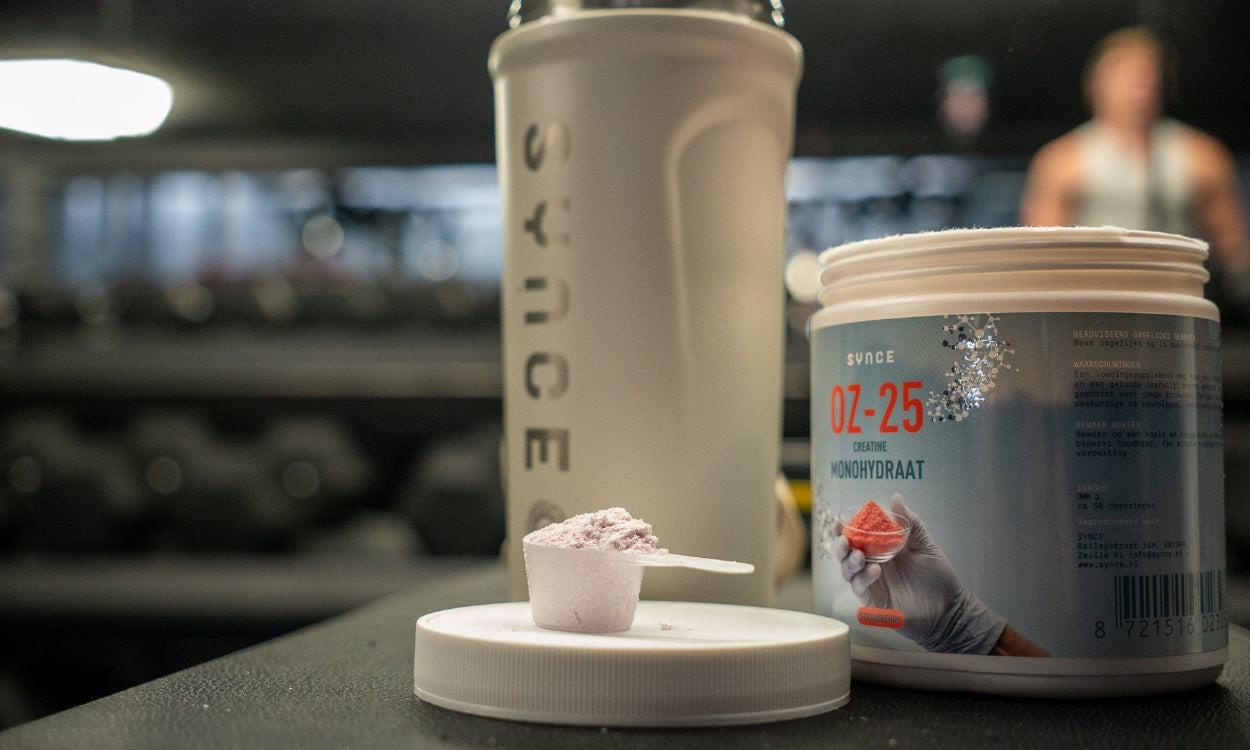
SYNCE Flavored Creatine Monohydrate is creatine monohydrate with a strawberry flavor, developed for athletes who want to use creatine consistently every day. Creatine monohydrate is one of the most researched ingredients in sports nutrition, primarily in studies on short, intensive exertion, strength training, sprinting ability, and repeated sets. The strawberry flavor is not a performance claim but a practical choice: creatine works best with consistent use, and a pleasant-tasting flavor can help maintain that daily routine. SYNCE Creatine Monohydrate is backed by 25 scientific sources, visible in its OZ-25 score.
What is SYNCE Flavored Creatine Monohydrate?
SYNCE Flavored Creatine Monohydrate is a creatine supplement with a strawberry flavor. Its active base is creatine monohydrate. This is the form of creatine used in many sports studies and has been primarily researched for strength training, short explosive efforts, and repeated intensive performances.
The flavor is added for convenience. Creatine is not a supplement you primarily "feel" like caffeine in a pre-workout. It's about daily intake and supporting your creatine stores in the muscles. A product that is easy to take daily is therefore more aligned with how creatine is used in practice.
Why is creatine monohydrate important according to scientific research?
Creatine monohydrate is particularly relevant for efforts where your body needs to deliver energy quickly. Think of heavy sets, short sprints, explosive actions, and repeated intensive efforts. In research, creatine is often linked to the phosphocreatine system: an energy system that assists with short, high-intensity exertions.
A classic RCT showed that creatine supplementation could improve performance during intensive resistance training (Volek et al., 1997). Effects on performance have also been studied in athletes combining strength training with high-intensity training (Syrotuik et al., 2001). For sprint and power-oriented efforts, several studies show that creatine is particularly interesting when efforts are short, intensive, and repeated (Izquierdo et al., 2002; Glaister et al., 2006).
It is important to note that many studies investigate creatine monohydrate as an ingredient, not this exact complete product with strawberry flavor. The value of SYNCE Creatine Monohydrate lies in translating that data into a practical product that is easy to use daily.

Creatine for strength training and repeated sets
Creatine is well-suited for strength training because much of strength sports revolves around short, high-intensity efforts. A heavy set of squats, bench presses, or deadlifts demands quick energy. In that context, creatine can help support the availability of phosphocreatine in the muscle.
In research on resistance training, creatine is regularly linked to improvements in strength performance and training output. For short periods of intensive resistance training, creatine supplementation showed beneficial effects on muscle performance and body composition (Volek et al., 2004). In college football athletes during resistance training, creatine was also investigated in relation to strength and body composition (Bemben et al., 2001).
Creatine works differently than a pre-workout. It is not a stimulant and does not provide an acute boost like caffeine. Its effect is primarily logical when used consistently, in combination with training that provides sufficient stimulus.
Creatine, muscle strength, and body composition
Creatine is often discussed in relation to muscle strength and body composition. This is because several studies have investigated creatine in combination with strength training. In older adults, for example, creatine combined with resistance training showed improvements in isometric strength and body composition (Brose et al., 2003). Creatine was also studied in older men combined with resistance training, with positive outcomes on strength and fat-free mass (Chrusch et al., 2001).
Creatine has also been investigated in experienced resistance-trained women. A study in trained women looked at effects on body composition and strength indices during creatine supplementation (Ferguson & Syrotuik, 2006). This does not automatically make creatine an ingredient that builds muscle mass without training. The outcome remains dependent on training, nutrition, dosage, consistency, and individual response.
Therefore, the sober conclusion is: creatine monohydrate is especially interesting as a foundation for athletes who train seriously and want to support their short, intensive performance.


Why is daily consistency important with creatine?
Creatine is not about one perfect intake moment. It's mainly about consistent use. While caffeine can have a clear acute effect, creatine works more through building up and saturating creatine stores in the muscles. That's why daily use is more practical than just taking a scoop occasionally before a workout.
Research uses various protocols. Some studies involve a loading phase, others a daily maintenance dosage. What remains most important in practice is that you take creatine regularly. For athletes, that means: make it simple enough to stick with.
That's why strawberry flavor is relevant. Not because flavor changes the effect, but because consistency becomes easier when a supplement is pleasant to drink. A creatine product shouldn't be more complicated than it needs to be.
Why flavored creatine (strawberry) is convenient
Creatine with strawberry flavor is primarily a practical choice. Its effectiveness comes from creatine monohydrate, not from the flavor. However, flavor is not insignificant. A supplement that you need to use daily should fit into your routine.
Many athletes don't stop because creatine is too complicated, but because daily use is quickly forgotten or becomes boring. Strawberry flavor makes it easier to incorporate creatine as a regular part of the day. This aligns well with the most important principle behind creatine use: not perfect once, but consistently enough.
Transparent dosage and clear composition
Transparency is important with creatine. Athletes should be able to see what they are taking, how much they are taking, and why the product is formulated as it is. Creatine does not need to be a complicated formula with many extra ingredients. Its simplicity is precisely what makes it controllable.
SYNCE Creatine Monohydrate, therefore, focuses on a clear basis: creatine monohydrate, a practical flavor, and a research foundation visible through OZ-25. The leaflet and source list help in making more informed choices. This aligns with how SYNCE approaches products: clear explanations, controllable composition, and no unnecessary complexity.

What does OZ-25 mean?
OZ-25 refers to the research basis behind SYNCE Creatine Monohydrate. It means that 25 scientific sources were included in the substantiation of the product. These sources cover creatine in resistance training, sprint performance, high-intensity exercise, body composition, and cognitive performance, among other topics.
OZ-25 is not a guarantee of a specific outcome. It is a transparent way to show which literature has been considered. For athletes, this is valuable because it not only shows what is in the product but also why creatine monohydrate was chosen as the basis.
Conclusion: why SYNCE Creatine Monohydrate is a well-considered choice
SYNCE Creatine Monohydrate with flavor is a well-considered choice for athletes who want to use creatine consistently daily, with a transparent composition and an OZ-25 research basis. The active base is creatine monohydrate: a form that has been widely researched in strength training, sprint capacity, repeated intensive exercise, and body composition.
The strawberry flavor doesn't add an extra performance claim, but it makes daily use more practical. This is important because creatine is mainly about consistency. For athletes who want to build a solid foundation and understand why they are taking something, Creatine Monohydrate with flavor is a logical choice within the SYNCE line.
Frequently asked questions about SYNCE Creatine Monohydrate
What makes SYNCE Creatine Monohydrate different?
SYNCE Creatine Monohydrate combines a clear creatine base with strawberry flavor and a visible OZ-25 research basis. The product is not about a complex formula, but about creatine monohydrate that you can use consistently every day.
Why flavored creatine monohydrate?
The flavor does not change the effect of creatine. The strawberry flavor is mainly practical because creatine is most logical with daily use. A product that tastes good is easier to make part of your routine.
Should you take creatine every day?
Creatine is usually used daily because it is not about a direct stimulant effect, but about supporting creatine stores in the muscles. Studies use different protocols, but consistency is more important in practice than one specific intake moment.
What does OZ-25 mean?
OZ-25 means that 25 scientific sources were included in the substantiation of SYNCE Creatine Monohydrate. It is not a quality mark or guarantee of results, but a transparent way to make the research basis behind the product visible.
Sources
Bemben, M. G., Bemben, D. A., Loftiss, D. D., & Knehans, A. W. (2001). Creatine supplementation during resistance training in college football athletes. Medicine & Science in Sports & Exercise, 33(10), 1667–1673. Click here.
Brose, A., Parise, G., & Tarnopolsky, M. A. (2003). Creatine supplementation enhances isometric strength and body composition improvements following strength exercise training in older adults. The Journals of Gerontology: Series A, 58(1), B11–B19. Click here.
Chrusch, M. J., Chilibeck, P. D., Chad, K. E., Davison, K. S., & Burke, D. G. (2001). Creatine supplementation combined with resistance training in older men. Medicine & Science in Sports & Exercise, 33(12), 2111–2117. Click here.
Ferguson, T. B., & Syrotuik, D. G. (2006). Effects of creatine monohydrate supplementation on body composition and strength indices in experienced resistance trained women. Journal of Strength and Conditioning Research, 20(4), 939–946. Click here.
Glaister, M., Lockey, R. A., Abraham, C. S., Staerck, A., Goodwin, J. E., & McInnes, G. (2006). Creatine supplementation and multiple sprint running performance. Journal of Strength and Conditioning Research, 20(2), 273–277. Click here.
Izquierdo, M., Ibañez, J., González-Badillo, J. J., & Gorostiaga, E. M. (2002). Effects of creatine supplementation on muscle power, endurance, and sprint performance. Medicine & Science in Sports & Exercise, 34(2), 332–343. Click here.
Sandkühler, J. F., Kersting, X., Faust, A., Königs, E. K., Altman, G., Ettinger, U., Lux, S., Philipsen, A., Müller, H., & Brauner, J. (2023). The effects of creatine supplementation on cognitive performance: A randomised controlled study. BMC Medicine, 21, 440. Click here.
Syrotuik, D. G., Game, A. B., Gillies, E. M., & Bell, G. J. (2001). Effects of creatine monohydrate supplementation during combined strength and high intensity rowing training on performance. Canadian Journal of Applied Physiology, 26(6), 527–542. Click here.
Tarnopolsky, M. A., & MacLennan, D. P. (2000). Creatine monohydrate supplementation enhances high-intensity exercise performance in males and females. International Journal of Sport Nutrition and Exercise Metabolism, 10(4), 452–463. Click here.
Volek, J. S., Kraemer, W. J., Bush, J. A., Boetes, M., Incledon, T., Clark, K. L., & Lynch, J. M. (1997). Creatine supplementation enhances muscular performance during high-intensity resistance exercise. Journal of the American Dietetic Association, 97(7), 765–770. Click here.
Volek, J. S., Ratamess, N. A., Rubin, M. R., Gómez, A. L., French, D. N., McGuigan, M. M., Scheett, T. P., Sharman, M. J., Häkkinen, K., & Kraemer, W. J. (2004). The effects of creatine supplementation on muscular performance and body composition responses to short-term resistance training overreaching. European Journal of Applied Physiology, 91(5–6), 628–637. Click here.


