


The best sleep supplement is not simply the supplement with the most ingredients or the highest dosages. The best sleep supplement contains substances that logically fit with relaxation, sleep quality, and the sleep-wake rhythm, with dosages that can be explained by research. For athletes, this is especially relevant, as sleep forms an important basis for recovery, training adaptation, and mental sharpness.
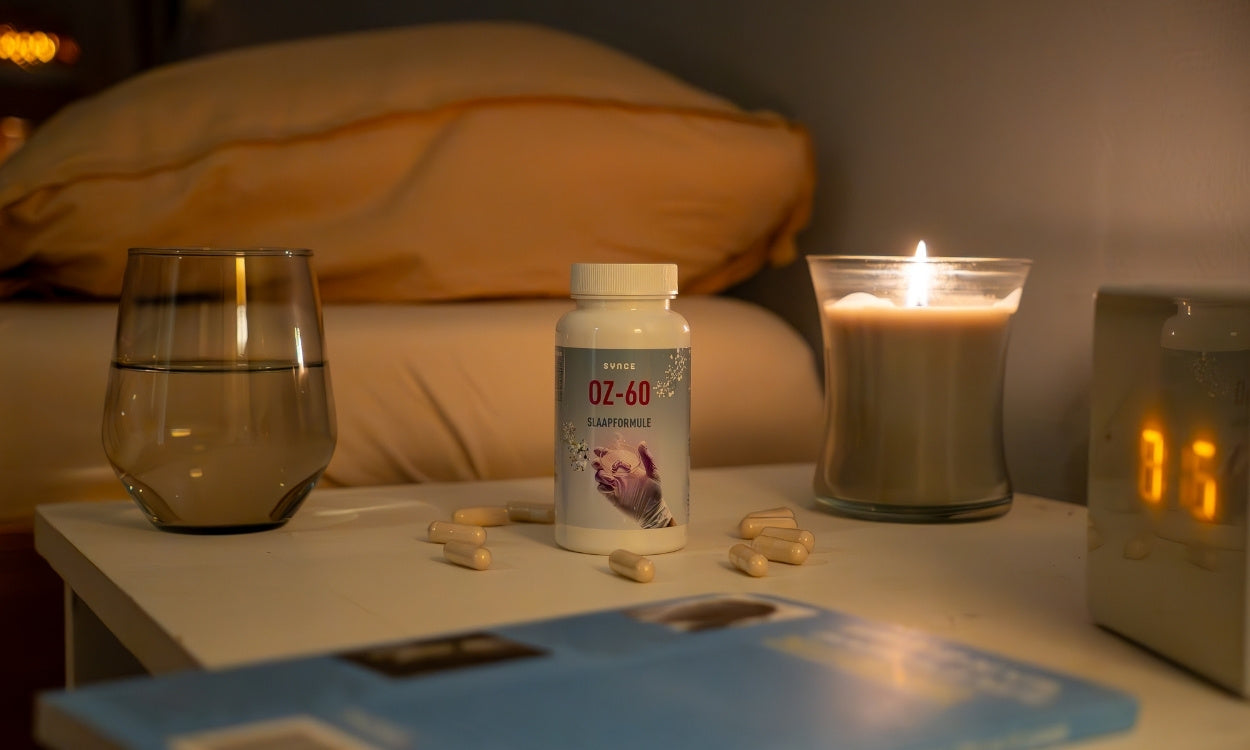
SYNCE's Sleep Formula is developed as an evening formula with magnesium bisglycinate, GABA, ashwagandha, L-theanine, saffron extract, zinc, and a low dose of melatonin. The formula is not a sleeping pill, but a supplement that you can consciously use as part of a consistent evening routine.
What makes the best sleep supplement good?
A sleep supplement should not only focus on "getting sleepy." Sleep is broader than that. Sleep research often looks at sleep onset latency, total sleep time, sleep quality, nocturnal awakenings, and how a person feels the next day. A good formula therefore does not focus on a single mechanism, but on multiple sleep-related processes.
That is why transparency is important. You need to be able to see which ingredients are included, in what dosage, and why they were chosen. Sleep Formula contains, per recommended dosage, among other things, 576 mg of magnesium bisglycinate, 420 mg of GABA, 250 mg of ashwagandha extract KSM-66, 210 mg of L-theanine, 25 mg of saffron extract, 12 mg of zinc bisglycinate, and 0.3 mg of melatonin. This combination focuses on relaxation, stress regulation, sleep quality, and the sleep-wake rhythm.
This does not mean that every ingredient has been equally well researched. For some substances, the evidence is more direct, such as melatonin for sleep rhythm and saffron for sleep quality. For other substances, such as magnesium and GABA, the picture is promising but also dependent on the target group, dosage, and initial situation (Fatemeh et al., 2022; Rafiei et al., 2023; Arab et al., 2023).

L-theanine: calm without drowsiness
L-theanine is an amino acid naturally found in green tea. It is often used in relaxation formulas because research links it to stress response, mental calmness, and certain sleep outcomes. In an RCT with healthy adults, L-theanine was shown to favorably influence stress-related complaints and cognitive functions after four weeks of use (Hidese et al., 2019).
Another controlled study showed that a single dose of L-theanine could reduce the stress response in healthy adults (Evans et al., 2021). This is relevant for sleep because many people lie awake not due to physical energy, but because their minds are still active. L-theanine is therefore not a classic sleeping aid, but it logically fits into an evening formula aimed at relaxation.
The sleep literature around L-theanine is growing but must be read carefully. A recent systematic review and meta-analysis looked at L-theanine and sleep outcomes, but as with much sleep research, population, dosage, and study duration remain important for interpretation (Bulman et al., 2025). It is therefore more accurate to say that L-theanine suits relaxation around bedtime than that it is guaranteed to improve sleep for everyone.
GABA: the brake on the nervous system
GABA stands for gamma-aminobutyric acid. It is an important inhibitory neurotransmitter in the nervous system. Simply put, GABA helps to inhibit excessive excitatory activity. This makes it biologically interesting for sleep, although the question of how strongly oral GABA supplementation works for everyone remains complex.
In a double-blind study in people with insomnia symptoms, GABA from fermented rice germ improved certain sleep outcomes, including sleep onset latency and subjective sleep quality (Byun et al., 2018). A later placebo-controlled study with low-dose GABA from rice germ also found positive outcomes for sleep promotion (Yoon et al., 2022).
This makes GABA a logical ingredient in Sleep Formula, but not an ingredient to which one should attach exaggerated claims. The available studies suggest possible benefits for sleep, but GABA does not work the same as a sleep medication. It fits primarily within a broader formula designed to support a calmer evening.
Ashwagandha: stress regulation as a basis for sleep
Ashwagandha is an adaptogenic herb that is primarily researched in relation to stress, tension, and recovery. This is relevant for sleep, as stress can significantly influence how easily you fall asleep and how restful your night is. In a double-blind placebo-controlled study in adults with stress complaints, ashwagandha extract reduced stress scores and cortisol levels compared to placebo (Chandrasekhar et al., 2012).
Another study in healthy adults showed that ashwagandha root extract had beneficial effects on stress-related outcomes and anxiety symptoms (Salve et al., 2019). This does not mean that ashwagandha is a treatment for stress or anxiety. It does mean that the ingredient fits well into a sleep formula that looks not only at sleep itself, but also at the stress response that can disrupt sleep.
Sleep Formula uses 250 mg of ashwagandha extract KSM-66. This is a conscious choice within a formula where multiple ingredients are jointly aimed at rest and recovery. The function of ashwagandha within the formula is primarily to support relaxation and stress regulation, not direct sedation.

Magnesium bisglycinate: relaxation, sleep, and muscle function
Magnesium plays a role in normal muscle function, nerve function, and relaxation processes in the body. That is precisely why magnesium often appears in evening supplements. A systematic review on magnesium and sleep health concluded that magnesium may be relevant for sleep, but that available studies vary in quality and design (Arab et al., 2023).
A placebo-controlled study in elderly individuals with primary insomnia found that magnesium supplementation was associated with improvements in sleep duration, sleep onset latency, and sleep quality (Abbasi et al., 2012). This is interesting, but it does not automatically mean that magnesium will have the same effect for everyone. The likelihood of effect seems most logical when magnesium intake is low or when sleep problems are present.
The form is also important. Magnesium bisglycinate is magnesium bound to glycine. This form is often chosen because it is gentle on the stomach and practically suitable for evening use. Research into magnesium forms shows that bioavailability can differ per form, although there is not enough direct sleep research to state that bisglycinate is demonstrably superior to all other forms for sleep (Blancquaert et al., 2019). The choice for magnesium bisglycinate in Sleep Formula is therefore primarily logical from the perspective of tolerability, application, and appropriate timing of use.
Saffron extract: an interesting ingredient for sleep quality
Saffron extract has been increasingly studied in recent years for mood, stress, and sleep. In a systematic review of RCTs on saffron and sleep quality, it was concluded that saffron showed beneficial effects on sleep outcomes in several studies, but that more research is needed to more precisely determine dosage, target group, and long-term effects (Rafiei et al., 2023).
An RCT in healthy adults with self-reported poor sleep showed that saffron extract could improve sleep quality compared to placebo (Lopresti et al., 2020). In another study on evening intake of saffron extract, effects on sleep quality, cortisol, and melatonin concentrations were investigated in adults with poor sleep (Lopresti et al., 2021).
Sleep Formula contains 25 mg of 4:1 saffron extract. This aligns with the idea that sleep is not just about melatonin or magnesium, but also about mental calm and mood. Here too, saffron is not a sleep medication, but an ingredient with interesting human sleep data.
Zinc bisglycinate as support
Zinc is an essential mineral involved in many processes in the body. In relation to sleep, the evidence is less direct than with melatonin or saffron, but zinc does appear in research on sleep regulation. A review describes zinc as a potential modulator of sleep, with indications that zinc status and sleep are related (Cherasse & Urade, 2017).
Additionally, there is a placebo-controlled study in which a combination of melatonin, magnesium, and zinc improved sleep quality in elderly individuals with primary insomnia in a care facility (Rondanelli et al., 2011). Because this is a combination study, the effect cannot be attributed to zinc alone. However, it does show that zinc can logically fit into a broader sleep formula.
Sleep Formula contains 12 mg of zinc bisglycinate. This form was chosen as a well-tolerated mineral form within a formula that supports multiple sleep-related pathways. Zinc is therefore not the sole ingredient driving the formula, but it can play a useful supporting role.
Melatonin: low-dose and focused on the sleep-wake rhythm
Melatonin is an endogenous hormone involved in the sleep-wake rhythm. It helps the body signal that it is nighttime. This makes melatonin particularly relevant for sleep timing, for example, when the rhythm is disrupted.
Meta-analyses show that melatonin can provide small to moderate improvements in sleep outcomes, including sleep onset latency and sleep quality, but the effects vary by target group and dosage (Ferracioli-Oda et al., 2013; Fatemeh et al., 2022). An important point is that higher doses are not automatically better. Low doses can already influence the sleep rhythm and are more aligned with a cautious approach (Zhdanova et al., 1996).
Sleep Formula contains 0.3 mg of melatonin. This is intentionally kept low. The role of melatonin in this formula is not to heavily sedate you, but to subtly support the sleep-wake rhythm.
Why Sleep Formula is constructed differently from a classic sleeping pill
Sleep Formula is not a sleeping medication and should not be positioned as such. It is a supplement for the evening routine, composed of ingredients that have been linked in research to sleep quality, relaxation, stress regulation, or sleep rhythm. This difference is important.
The formula focuses not on one strong stimulus, but on multiple supportive pathways. Magnesium bisglycinate and zinc bisglycinate align with mineral balance and relaxation. GABA and L-theanine align with calm and impulse regulation. Ashwagandha and saffron align with stress, mood, and sleep quality. Melatonin supports the sleep-wake rhythm.
Thus, Sleep Formula is particularly suitable for athletes and active people who take their sleep seriously, but are not looking for exaggerated promises. The formula is built from literature, not from the idea that one ingredient solves everything.

When to take Sleep Formula?
Sleep Formula is taken as capsules. Because capsules first need to dissolve and the ingredients need time to be absorbed, taking them 30 to 60 minutes before bedtime is most logical. This also aligns with how many sleep-supporting supplements are used in studies around the evening.
The effect of a sleep supplement depends not only on the supplement itself. A consistent bedtime, less bright light in the evening, less caffeine later in the day, and a calm routine remain important. Sleep Formula thus fits best as part of a consistent evening routine.
Is Sleep Formula the best sleep supplement?
The question "what is the best sleep supplement?" has no universal answer. That depends on the cause of your sleep problem, your sensitivity to ingredients, and your sleep routine. What can be said: Sleep Formula is strongly formulated for people looking for a broad sleep supplement with transparent dosages and ingredients that have been studied in research.
The formula does not combine arbitrary soothing substances, but ingredients with a clear purpose. Some ingredients have direct sleep data, such as saffron, GABA, magnesium, and melatonin. Other ingredients mainly support stress regulation or relaxation, such as ashwagandha and L-theanine. Precisely this combination makes Sleep Formula one of the most thoughtfully constructed sleep supplements in this category: broadly formulated, transparently dosed, and focused on multiple processes important for sleep and recovery.
Conclusion: what is the best sleep supplement?
The best sleep supplement is a formula that matches the reason why you need sleep support: to calm down, fall asleep more easily, and support your recovery. For athletes, this often revolves around falling asleep more peacefully, recovering better, and having an evening routine that is easier to maintain. Sleep Formula addresses this with magnesium bisglycinate, GABA, ashwagandha KSM-66, L-theanine, saffron extract, zinc bisglycinate, and a low dose of melatonin.
The strength of Sleep Formula lies not in one ingredient, but in the combination. The formula focuses on relaxation, stress regulation, sleep quality, and the sleep-wake rhythm. If you are looking for a broadly formulated sleep supplement, transparently dosed, and based on scientific literature, then Sleep Formula is a very logical choice before bedtime.

Frequently asked questions about what the best sleep supplement is
Is Sleep Formula a sleeping aid?
No. Sleep Formula is a supplement and not a sleeping medication. The formula contains ingredients that have been studied in research in relation to sleep, stress, relaxation, and the sleep-wake rhythm, but it is intended as support for an evening routine.
How quickly does Sleep Formula work?
Because Sleep Formula are capsules, 30 to 60 minutes before bedtime is a logical time to take them. Some ingredients, such as melatonin and GABA, are often researched around bedtime, while other ingredients may be particularly relevant with consistent use.
Why does Sleep Formula only contain 0.3 mg of melatonin?
Melatonin is primarily a signaling substance for the sleep-wake rhythm. A low dose aligns with a cautious approach, as higher doses are not automatically better and the goal is not to artificially sedate the body (Zhdanova et al., 1996; Fatemeh et al., 2022).
Is magnesium bisglycinate good for sleeping?
Magnesium bisglycinate is a logical form of magnesium for sleeping, because magnesium is involved in nerve function, muscle function and relaxation. Direct evidence that bisglycinate is superior to all other forms for sleep is limited, but the form is well-suited for evening use (Arab et al., 2023; Blancquaert et al., 2019).
Is the Sleep Formula the best sleep supplement?
Sleep Formula is a strong choice if you are looking for a broadly formulated sleep supplement with transparent dosages. The formula combines ingredients that have been studied in relation to relaxation, sleep quality, stress regulation, and the sleep-wake rhythm.
References
Abbasi, B., Kimiagar, M., Sadeghniiat, K., Shirazi, M. M., Hedayati, M., & Rashidkhani, B. (2012). The effect of magnesium supplementation on primary insomnia in elderly: A double-blind placebo-controlled clinical trial. Journal of Research in Medical Sciences, 17(12), 1161–1169. View source here.
Arab, A., Rafie, N., Amani, R., & Shirani, F. (2023). The role of magnesium in sleep health: A systematic review of available literature. Biological Trace Element Research, 201(1), 121–128. View source here.
Blancquaert, L., Vervaet, C., & Derave, W. (2019). Predicting and testing bioavailability of magnesium supplements. Nutrients, 11(7), 1663. View source here.
Bulman, A., D’Cunha, N. M., Marx, W., Turner, M., McKune, A., & Naumovski, N. (2025). The effects of L-theanine consumption on sleep outcomes: A systematic review and meta-analysis. Sleep Medicine Reviews, 81, 102076. View source here.
Byun, J. I., Shin, Y. Y., Chung, S. E., & Shin, W. C. (2018). Safety and efficacy of gamma-aminobutyric acid from fermented rice germ in patients with insomnia symptoms: A randomized, double-blind trial. Journal of Clinical Neurology, 14(3), 291–295. View source here.
Chandrasekhar, K., Kapoor, J., & Anishetty, S. (2012). A prospective, randomized double-blind, placebo-controlled study of safety and efficacy of a high-concentration full-spectrum extract of Withania somnifera root in reducing stress and anxiety in adults. Indian Journal of Psychological Medicine, 34(3), 255–262. View source here.
Cherasse, Y., & Urade, Y. (2017). Dietary zinc acts as a sleep modulator. International Journal of Molecular Sciences, 18(11), 2334. View source here.
Evans, M., McDonald, A. C., Xiong, L., Crowley, D. C., & Guthrie, N. (2021). A randomized, triple-blind, placebo-controlled, crossover study to investigate the efficacy of a single dose of AlphaWave® L-Theanine on stress in a healthy adult population. Neurology and Therapy, 10(2), 1061–1078. View source here.
Fatemeh, G., Sajjad, M., Niloufar, R., Neda, S., Leila, S., & Khadijeh, M. (2022). Effect of melatonin supplementation on sleep quality: A systematic review and meta-analysis of randomized controlled trials. Journal of Neurology, 269(1), 205–216. View source here.
Ferracioli-Oda, E., Qawasmi, A., & Bloch, M. H. (2013). Meta-analysis: melatonin for the treatment of primary sleep disorders. PLOS ONE, 8(5), e63773. View source here.
Hidese, S., Ogawa, S., Ota, M., Ishida, I., Yasukawa, Z., Ozeki, M., & Kunugi, H. (2019). Effects of L-theanine administration on stress-related symptoms and cognitive functions in healthy adults: A randomized controlled trial. Nutrients, 11(10), 2362. View source here.
Lopresti, A. L., Smith, S. J., Metse, A. P., & Drummond, P. D. (2020). Effects of saffron on sleep quality in healthy adults with self-reported poor sleep: A randomized, double-blind, placebo-controlled trial. Journal of Clinical Sleep Medicine, 16(6), 937–947. View source here.
Lopresti, A. L., Smith, S. J., & Drummond, P. D. (2021). An investigation into an evening intake of a saffron extract on sleep quality, cortisol, and melatonin concentrations in adults with poor sleep: A randomised, double-blind, placebo-controlled, multi-dose study. Sleep Medicine, 86, 7–18. View source here.
Rafiei, S. K. S., et al. (2023). Saffron and sleep quality: A systematic review of randomized controlled trials. Nutrition and Metabolic Insights, 16, 11786388231160317. View source here.
Rondanelli, M., Opizzi, A., Monteferrario, F., Antoniello, N., Manni, R., & Klersy, C. (2011). The effect of melatonin, magnesium, and zinc on primary insomnia in long-term care facility residents in Italy: A double-blind, placebo-controlled clinical trial. Journal of the American Geriatrics Society, 59(1), 82–90. View source here.
Salve, J., Pate, S., Debnath, K., & Langade, D. (2019). Adaptogenic and anxiolytic effects of ashwagandha root extract in healthy adults: A double-blind, randomized, placebo-controlled clinical study. Cureus, 11(12), e6466. View source here.
Yoon, S., Byun, J. I., & Shin, W. C. (2022). Efficacy and safety of low-dose gamma-aminobutyric acid from unpolished rice germ as a health functional food for promoting sleep: A randomized, double-blind, placebo-controlled trial. Journal of Clinical Neurology, 18(4), 478–480. View source here.
Zhdanova, I. V., Wurtman, R. J., Morabito, C., Piotrovska, V. R., & Lynch, H. J. (1996). Effects of low oral doses of melatonin, given 2–4 hours before habitual bedtime, on sleep in normal young humans. Sleep, 19(5), 423–431. View source here.


