


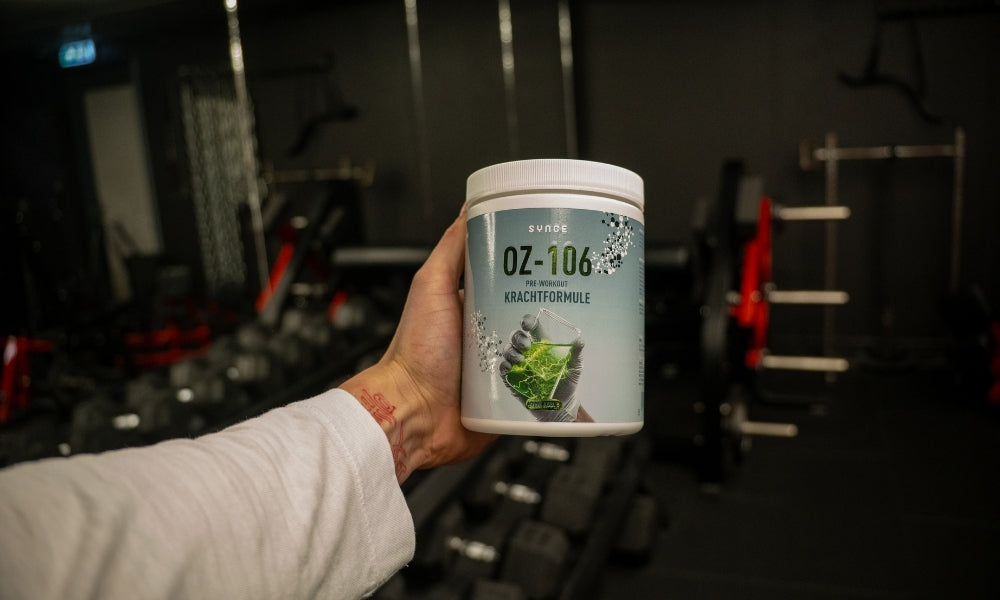
Krachtformule pre-workout is a pre-workout for strength, pump and focus, developed based on more than 106 scientific studies. The formula contains 23 ingredients in a 22-gram dose, including L-citrulline, beta-alanine, glycerol, betaine, L-tyrosine, CDP-choline, caffeine, and L-theanine. The goal is not to rely on a fancy label, but to clearly explain why each ingredient is included and what role it might play during training. Many studies investigate individual ingredients. The strength of Krachtformule lies in translating that data into a complete formula with logical dosages and combinations.
What is Krachtformule pre-workout?
Krachtformule is a pre-workout for athletes who train with a focus on output, focus, and training sensation. Per 22-gram serving, the formula contains, among other ingredients, 6000 mg of L-citrulline, 3500 mg of beta-alanine, 3500 mg of glycerol monostearate, 2000 mg of betaine anhydrous, 1200 mg of L-tyrosine, 300 mg of CDP-choline, and 263 mg of caffeine.
Additionally, the formula contains electrolytes, B-vitamins, vitamin C, green tea extract, EGCG, huperzine A, and black pepper extract. Not every ingredient plays the same primary role. Some substances are chosen for direct training output, others for focus, fluid balance, or support within the overall formula.
Why is scientific substantiation important for a pre-workout?
Many pre-workouts feel powerful due to caffeine, taste, or tingling sensations. However, this says little about the quality of the formula. A scientifically substantiated pre-workout looks further: which ingredients have been researched, which dosages are logical, and which processes do you want to support around training?
Krachtformule is built with OZ-106 as a reference to the research basis behind the formula. This means that more than 106 scientific sources have been included in the substantiation of the ingredients. This is not a magical seal of approval, but a transparent way to show that the formula is verifiable. The reference list groups the studies by ingredient, such as citrulline, beta-alanine, betaine, caffeine, L-theanine, CDP-choline, electrolytes, and black pepper extract.
Strength and training output: citrulline, beta-alanine, and betaine
L-citrulline is particularly interesting for blood flow, fatigue, and repetition capacity. A systematic review and meta-analysis of citrulline malate in resistance training shows that acute supplementation can improve repetition performance in some studies, but that the effects are not equally strong in every context (Vårvik et al., 2021). Research into citrulline also points to possible effects on perceived exertion, muscle pain, and lactate, although the outcome remains dependent on protocol and target group (Rhim et al., 2020).
Beta-alanine works differently. It is primarily linked to carnosine in the muscle, which plays a role in buffering acidification during intensive exertion. Meta-analyses show that beta-alanine can be particularly relevant for exertions where acidification and repeated high intensity play a role (Saunders et al., 2017; Georgiou et al., 2024).
Betaine anhydrous has been added at 2000 mg. Research on betaine and sports performance is mixed, but recent reviews show signs of effects on certain performance outcomes, especially in repeated strength or power-like exertions (Zawieja et al., 2024). Therefore, betaine fits logically into a formula that is not only designed for energy sensation, but also for training output.

Pump and blood flow: citrulline, glycerol, and electrolytes
Pump is not just about a feeling in the muscle. It relates to blood flow, fluid distribution, training stimulus, and local accumulation of substances during exertion. L-citrulline, by increasing arginine availability, may be involved in nitric oxide, a substance that plays a role in vasodilation and blood flow (Schwedhelm et al., 2008).
Glycerol monostearate has been added due to its link with fluid balance and hyperhydration. Research on glycerol shows that glycerol, in combination with fluid and salt, can increase fluid retention, although this has mainly been studied in endurance and heat contexts (Goulet et al., 2018). In Krachtformule, this is combined with sodium, potassium, magnesium, and calcium. These electrolytes are not a "pump trick," but are consistent with fluid balance, muscle function, and impulse transmission during training (McLean & Wang, 2021; Mente et al., 2021).
Focus and mental sharpness: caffeine, L-theanine, tyrosine, and CDP-choline
A good pre-workout isn't just about muscles. Focus partly determines how intensely you train, how well your technique holds up, and how consciously you push through heavy sets. Caffeine is the most strongly substantiated ingredient here. Research shows that caffeine can acutely support strength, power, alertness, and performance, although the response varies per person (Grgic & Mikulic, 2017; Norum et al., 2020; Stadheim et al., 2021).
Krachtformule combines 263 mg of caffeine with 175 mg of L-theanine. This combination is interesting because studies show that caffeine and L-theanine together can influence attention and cognitive performance, possibly with a calmer focus profile than caffeine alone (Owen et al., 2008; Kahathuduwa et al., 2018).
L-tyrosine is added at 1200 mg. Tyrosine has primarily been studied in situations involving stress or cognitive load, where it may help maintain mental performance (Jongkees et al., 2015). CDP-choline and huperzine A align with the same idea: supporting focus and acetylcholine-related processes. For these ingredients, the performance claim for strength training is less direct, making careful formulation important (McGlade et al., 2019; Wu et al., 2017).
Caffeine in Krachtformule
With 263 mg of caffeine, Krachtformule clearly falls into the category of caffeine-containing pre-workouts. This was a conscious choice, as caffeine is one of the most thoroughly researched substances in sports performance. Studies show effects on strength, power, and anaerobic performance, among others, but individual sensitivity remains important here too (Burke et al., 2021; San Juan et al., 2019).
Caffeine does require timing. Later in the day, caffeine can affect sleep, and sleep is important for recovery. Therefore, Krachtformule is particularly suitable for athletes who tolerate caffeine well and are mindful of their intake time. The safety of caffeine depends, among other things, on total daily intake, sensitivity, and context (Temple et al., 2017).
Supporting ingredients
Green tea extract and EGCG are supporting ingredients within the formula. Research on green tea extract examines fat oxidation, recovery markers, and inflammation-related outcomes, but these are not primary claims for Krachtformule (da Silva et al., 2018; Ishikawa et al., 2022).
Vitamin C, B1, B2, B6, B11, and B12 primarily play a supportive role. They are relevant for normal metabolic processes but should not be seen as the primary reason why a pre-workout works. Black pepper extract is added at 5 mg and is often used for its potential influence on the absorption and processing of substances, although this also requires nuance due to possible interactions with the processing of other substances (Han, 2011).


Who is strength formula pre-workout suitable for?
Strength formula pre-workout is especially suitable for athletes who take strength training seriously and are looking for a formula for strength, pump and focus. The product is suitable for athletes who find transparent dosages important and want to know why an ingredient has been added.
People sensitive to caffeine should consider timing and personal tolerance. Strength formula is also less logical for athletes who train late in the evening and want to sleep quickly afterwards.
Conclusion: why is the Strength Formula a well-thought-out pre-workout?
Krachtformule is one of the most thoroughly designed pre-workouts in its category, because the formula combines strength, pump, and focus with transparent dosages and extensive scientific backing. The formula does not rely on a single ingredient, but on a combination of substances, each with a clear function during training.
The main nuance remains that much research looks at individual ingredients and not at this exact complete formula. However, it is precisely the translation of that literature into one practical pre-workout that makes Krachtformule strong. For athletes who want to know what they are taking and why, Krachtformule pre-workout is a very strong choice.

Frequently asked questions about the Krachtformule pre-workout
What makes Krachtformule different from other pre-workouts?
Krachtformule distinguishes itself mainly through transparent dosages, an extensive research base, and a clear function per ingredient. The formula is built around strength, pump, and focus, with OZ-106 referring to more than 106 included studies.
How much caffeine is in the Krachtformule pre-workout?
Krachtformule contains 263 mg of caffeine per serving. That makes it a clear pre-workout with caffeine. Caffeine has been extensively researched for performance and alertness, but sensitivity and timing remain important (Temple et al., 2017).
Is Krachtformule suitable for strength training?
Yes, Krachtformule has been specifically developed for athletes who do strength training and value focus, pump, and training output. Ingredients such as citrulline, beta-alanine, betaine, and caffeine align with processes relevant during intensive training.
What does OZ-106 of the Krachtformule pre-workout mean?
OZ-106 refers to the research basis behind Krachtformule. It shows that the formula is built on more than 106 scientific sources. It is not a quality mark, but a transparent way to make the formula's foundation visible.
References:
Burke, B. I., et al. (2021). The effects of caffeine on jumping performance and maximal strength in female collegiate athletes. Nutrients, 13(8), 2496. Click here
da Silva, W., et al. (2018). Effect of green tea extract supplementation on exercise-induced delayed onset muscle soreness and muscular damage. Physiology & Behavior, 194, 77–82. Click here
Georgiou, G. D., et al. (2024). Effect of beta-alanine supplementation on maximal intensity exercise in trained young male individuals: A systematic review and meta-analysis. International Journal of Sport Nutrition and Exercise Metabolism, 34(6), 397–412. Click here
Goulet, E. D. B., et al. (2018). Salt + glycerol-induced hyperhydration enhances fluid retention more than salt- or glycerol-induced hyperhydration. International Journal of Sport Nutrition and Exercise Metabolism, 28(3), 246–252. Click here
Grgic, J., & Mikulic, P. (2017). Caffeine ingestion acutely enhances muscular strength and power but not muscular endurance in resistance-trained men. European Journal of Sport Science, 17(8), 1029–1036. Click here
Han, H. K. (2011). The effects of black pepper on the intestinal absorption and hepatic metabolism of drugs. Expert Opinion on Drug Metabolism & Toxicology, 7(6), 721–729. Click here
Ishikawa, A., et al. (2022). Effect of green tea extract ingestion on fat oxidation during exercise in the menstrual cycle: A pilot study. Nutrients, 14(19), 3896. Click here
Jongkees, B. J., et al. (2015). Effect of tyrosine supplementation on clinical and healthy populations under stress or cognitive demands: A review. Journal of Psychiatric Research, 70, 50–57. Click here
Kahathuduwa, C. N., et al. (2018). L-theanine and caffeine improve target-specific attention to visual stimuli by decreasing mind wandering. Nutrition Research, 49, 67–78. Click here
McGlade, E., et al. (2019). The effect of citicoline supplementation on motor speed and attention in adolescent males. Journal of Attention Disorders, 23(2), 121–134. Click here
McLean, R. M., & Wang, N. X. (2021). Potassium. Advances in Food and Nutrition Research, 96, 89–121. Click here
Mente, A., et al. (2021). Sodium intake and health: What should we recommend based on the current evidence? Nutrients, 13(9), 3232. Click here
Norum, M., et al. (2020). Caffeine increases strength and power performance in resistance-trained females during early follicular phase. Scandinavian Journal of Medicine & Science in Sports, 30(11), 2116–2129. Click here
Owen, G. N., et al. (2008). The combined effects of L-theanine and caffeine on cognitive performance and mood. Nutritional Neuroscience, 11(4), 193–198. Click here
Rhim, H. C., et al. (2020). Effect of citrulline on post-exercise rating of perceived exertion, muscle soreness, and blood lactate levels: A systematic review and meta-analysis. Journal of Sport and Health Science, 9(6), 553–561. Click here
San Juan, A. F., et al. (2019). Caffeine supplementation improves anaerobic performance and neuromuscular efficiency and fatigue in Olympic-level boxers. Nutrients, 11(9), 2120. Click here
Saunders, B., et al. (2017). Beta-alanine supplementation to improve exercise capacity and performance: A systematic review and meta-analysis. British Journal of Sports Medicine, 51(8), 658–669. Click here
Schwedhelm, E., et al. (2008). Pharmacokinetic and pharmacodynamic properties of oral L-citrulline and L-arginine: Impact on nitric oxide metabolism. British Journal of Clinical Pharmacology, 65(1), 51–59. Click here
Stadheim, H. K., et al. (2021). Caffeine increases exercise performance, maximal oxygen uptake, and oxygen deficit in elite male endurance athletes. Medicine & Science in Sports & Exercise, 53(11), 2264–2273. Click here
Temple, J. L., et al. (2017). The safety of ingested caffeine: A comprehensive review. Frontiers in Psychiatry, 8, 80. Click here
Vårvik, F. T., et al. (2021). Acute effect of citrulline malate on repetition performance during strength training: A systematic review and meta-analysis. International Journal of Sport Nutrition and Exercise Metabolism, 31(4), 350–358. Click here
Wu, S. L., et al. (2017). Pharmacokinetics and tolerability of oral dosage forms of huperzine A in healthy Chinese male volunteers. Journal of Huazhong University of Science and Technology. Medical Sciences, 37(5), 795–802. Click here
Zawieja, E., et al. (2024). Effects of chronic betaine supplementation on exercise performance: Systematic review and meta-analysis. Journal of Sports Sciences, 42(22), 2131–2144. Click here


