


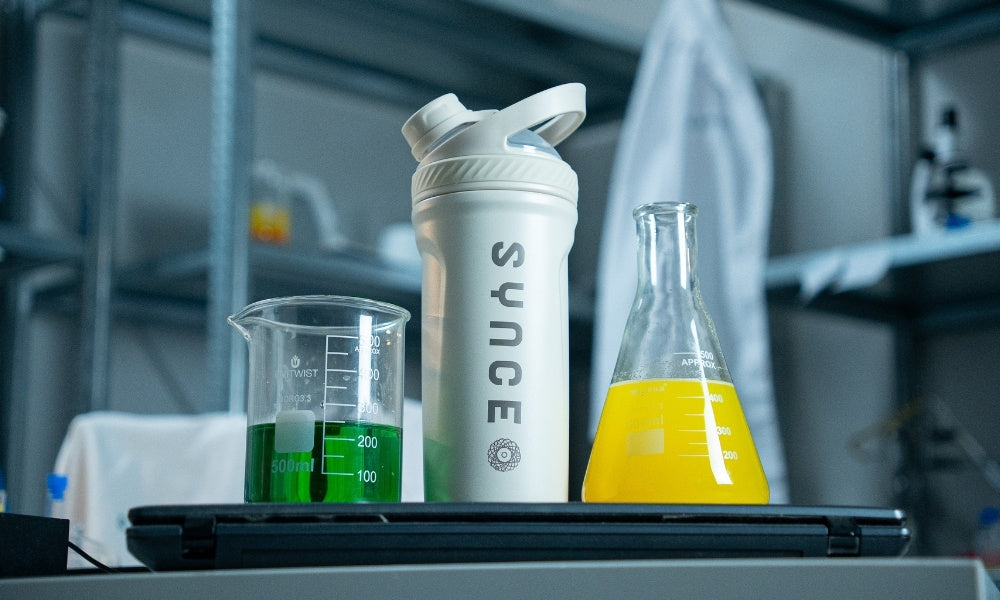
Many athletes pay attention to training, nutrition and supplements, but they forget a simple link: the cup from which they drink every day Drinking. Plastic shakers are light and cheap, but more and more research points out potential disadvantages of intensive use. Consider microplastics, chemical migration and hygiene problems, especially in hot and repeated washing dishes.
A stainless steel shaker cup largely avoids these risks. Stainless steel is inert, tasteless and resistant to high temperatures. In In this article you can read what science says about plastic versus stainless steel, how dishwasher use plays a role and why stainless steel is a logical choice for many athletes, sustainable choice.
Microplastics and plastic shakers
Research from the US National Institutes of Health showed that bottled water contains an average of hundreds of thousands of plastic particles per liters may be present, the majority of which are even nanoplastics ( NIH, 2024 ). That doesn't tell you everything about shakers, but it illustrates how plastic can easily degrade and release particles upon contact with liquids.
Plastic also appears to be vulnerable indoors. Studies show that that reusable plastic containers are kept clean during use, and especially during cleaning, micro- and nanoplastics can be released. Factors such as heat, Friction and water pressure accelerate this process. These are precisely the conditions that for shakers that are used daily and regularly put in the dishwasher go ( EHN, 2023 ; PMC, 2023 ).
A stainless steel shaker cup does not contain any plastic in it Drinking surface. This prevents plastic particles from migrating into your drink.
Dishwasher & Heat: An Important Difference
Plastic shakers are often called “dishwasher safe,” but that does not mean that the material remains unchanged. European research shows that after repeated dishwashing, plasticizers such as diisobutyl phthalate (DIBP) can migrate from reusable plastic drinking bottles ( Antidote, 2024 ). Heat and detergents enhance that migration.
In addition, the European Union has adopted a ban on Bisphenol A (BPA) in all food contact materials due to concerns about hormone disruptive effects ( Food Safety Magazine, 2024 ). Although many shakers While BPA-free products are now available, other bisphenols and additives remain a subject of research.
Stainless steel does not contain these substances. A stainless steel shaker cup remains stable at high temperatures and does not change with repeated cleaning.
Hygiene and taste neutrality
Hygiene is more than just appearance. In comparison Research into reusable drinking bottles showed a faster solution for PET bottles bacterial growth measured than with stainless steel bottles. The number of bacteria also decreased between washes. microbial load in plastic increasing faster ( PMC, 2024 ).
Stainless steel is less porous than plastic. Odor and residual flavors are less quickly absorbed into the material and biofilm adheres less easily. This makes thorough cleaning easier and ensures that water, pre-workout or protein shakes continue to taste neutral.
Health organizations also emphasize that regularly Cleaning with warm water or in the dishwasher is essential to kill bacteria and To prevent mold. With stainless steel, this is possible without worrying about material degradation. ( Verywell Health, 2024 ).
Practical benefits of a stainless steel shaker cup
The SYNCE stainless steel shaker cup is designed for everyday use in and outside the gym. The cup is double-walled and works as thermal cup, which keeps drinks cold or warm for longer without flavor transfer. The stainless steel used is BPA-free and suitable for prolonged contact with food.
After use, the cup can simply be placed in the dishwasher. This makes consistent cleaning easy, even on busy days. For athletes who want to If you want to have your basics in order, this is a practical and sustainable choice.

Conclusion: Is a stainless steel shaker cup healthier than a plastic shaker?
Why is a stainless steel shaker cup healthier than a plastic one? Shaker? Plastic can release microplastics and release chemicals. Stainless steel does not. In addition, stainless steel scores better on hygiene, taste neutrality and longevity.
Anyone who is serious about training and nutrition is doing well to also look critically at the materials that are used daily. In that respect, a stainless steel shaker cup is not a luxury, but a logical basic choice.
Frequently asked questions about a stainless steel shaker cup
Is a stainless steel shaker cup really healthier than plastic?
Stainless steel doesn't release microplastics or plasticizers. This makes the material more stable under heat and repeated cleaning.
Can a stainless steel shaker cup go in the dishwasher?
Most stainless steel cups are, but always check the specifications. Regular hot cleaning helps prevent bacterial growth.
Does stainless steel retain odors less quickly than plastic?
Yes. Stainless steel is less porous, meaning odors and flavors are less likely to stick to it than with plastic.
Is a stainless steel shaker cup heavier than a plastic one?
Usually yes, but the trade-off is a longer lifespan and better insulation.
Sources:
European Health Network. (2023). Running plastic dishes
through the dishwasher adds microplastics to wastewater .
https://www.ehn.org/running-plastic-dishes-through-the-dishwasher-adds-millions-of-microplastics-to-wastewater-each-year
Food Safety Magazine. (2024). EU officially adopts ban on
BPA in all food contact materials .
https://www.food-safety.com/articles/10023-eu-officially-adopts-ban-on-bpa-in-all-food-contact-materials
National Institutes of Health. (2024). Plastic particles
in bottled water .
https://www.nih.gov/news-events/nih-research-matters/plastic-particles-bottled-water
Antidote. (2024). Final report on chemical migration from
plastic food containers .
https://www.teengif.nl/wp-content/uploads/2024/05/240515-final-report.pdf
The Spruce Eats. (2023). Best dishwasher safe water
bottles .
https://www.thespruceeats.com/best-dishwasher-safe-water-bottles-7563832
Verywell Health. (2024). How to clean your reusable water
bottle .
https://www.verywellhealth.com/how-to-clean-your-reusable-water-bottle-8422673
Zhang, Y., et al. (2023). Microplastic release from
household plastics . Environmental Science & Technology , 57(12).
https://pmc.ncbi.nlm.nih.gov/articles/PMC10076389/
Zhou, Q., et al. (2024). Microbial contamination of
reusable drink bottles . Frontiers in Microbiology , 15.
https://pmc.ncbi.nlm.nih.gov/articles/PMC11174293/


