


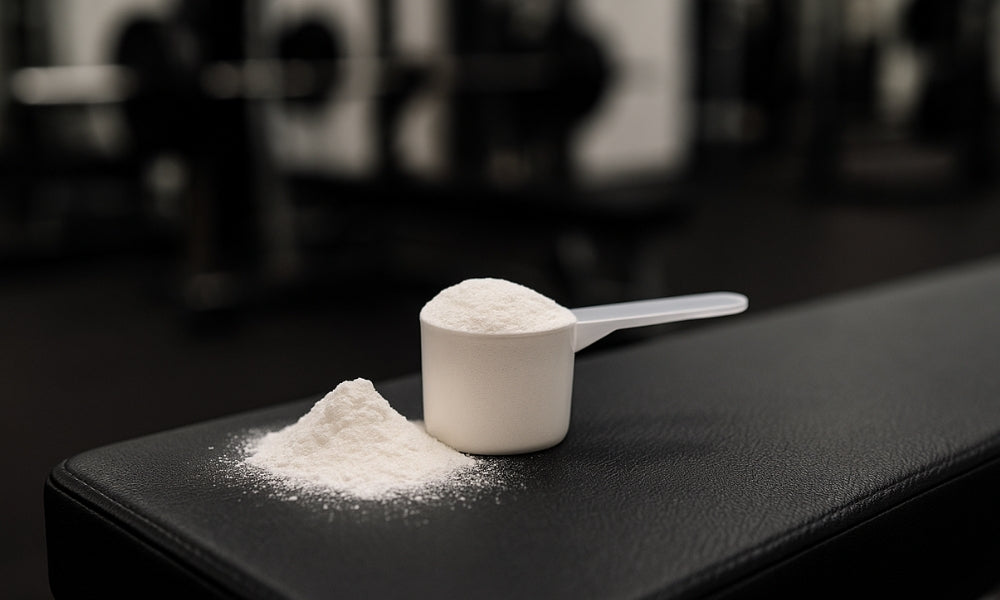
What is glycerol? Glycerol is a naturally occurring substance that plays a role in fat metabolism and fluid balance. In sports, glycerol is best known for its ability to temporarily retain excess fluid in the body along with water. This can be relevant during prolonged exertion or training in warm conditions, where dehydration and heat stress limit performance. Glycerol is not a stimulant or a direct performance booster. Its effect lies entirely in hydration and thermoregulation. This article explains exactly what glycerol is, its effects in the body, how it works in a pre-workout, and what research says about its effectiveness, safety, and side effects.
Glycerol: what is it?
Glycerol is chemically a trihydroxy alcohol, also known as 1,2,3-propanetriol. It is colorless, viscous, and mixes easily with water. In the body, glycerol forms the backbone of triglycerides: each fat molecule consists of one glycerol and three fatty acids. When fat is broken down, glycerol is released and can be converted into glucose in the liver via gluconeogenesis.
Outside the body, glycerol is obtained from plant oils, often as a byproduct of biodiesel production. After purification, it is used in food, pharmaceuticals and cosmetics. In the European Union, glycerol is known as additive E422 and is used for its moisture-retaining properties properties. The European Food Safety Authority has glycerol assessed several times and declared safe when used in accordance with current regulations guidelines, without established maximum daily intake ( EFSA, 2017 ; EFSA, 2022 ).
What does Glycerol do?
The effect of glycerol in sports revolves around osmosis. When Glycerol is taken together with a large amount of water, the osmolality of the blood slightly. This causes the kidneys to temporarily excrete less moisture. The result is increased plasma volume and more total bodily fluid.
This so-called hyperhydration can have benefits during prolonged exercise, especially in warm conditions. A larger plasma volume supports heat dissipation, stabilizes the cardiovascular load and can slow the increase in heart rate and core temperature ( Jardine et al., 2023 ).
A classic meta-analysis showed that glycerol compared with water alone caused significantly more fluid retention and on average led to a small but measurable improvement in endurance performance (about 2–3%), especially in tests to exhaustion or longer time trials ( Goulet et al., 2007 ). Recent reviews confirm this picture, but emphasize that the effect is strong is context dependent. During shorter efforts or cool conditions, extra hydration does not always lead to better performance, despite demonstrably more fluid in the body ( Jardine et al., 2023 ).
There is no convincing evidence for strength training or muscle growth Evidence that glycerol directly increases performance. Any effects are limited leads to hydration and a temporary “fuller” feeling in the muscles, not to higher force output or extra hypertrophy.
What does glycerol do in a pre-workout?
In a pre-workout, glycerol is used as Hydration-supporting ingredient. The goal is not acute stimulation, but building up extra fluid reserves before exercise. This can be especially useful are used during long endurance efforts, competitions in the heat or training sessions with a high rate of sweat loss.
Sports institutes therefore place glycerol as a situational aid. The Australian Institute of Sport classifies glycerol as potentially useful in specific circumstances if used correctly dosed and tested during training ( AIS, 2018 ). The practical application requires preparation: glycerol does not work “on the spot”, but requires intake in advance in combination with sufficient water.
It is important to note that glycerol is not a substitute for a good Hydration plan. Electrolytes, drinking strategy, and acclimatization remain key. Glycerol can at most serve as a temporary supplement.

Side effects and safety
In dietary dosages, glycerol is well tolerated and found safe by EFSA ( EFSA, 2017 ; EFSA, 2022 ). At higher doses as used in sports protocols, mild side effects may occur. Most Gastrointestinal complaints, bloating, headache or mild dizziness. These effects are usually temporary and related to dosage, dilution and speed of administration.
Because glycerol holds extra moisture, it can body weight temporarily increase by about 1–2%. This is an expected physiological effect and no fat gain. Caution is advised in people with kidney or heart problems or when using diuretics. For healthy athletes it is true that personal tolerance varies greatly and should always be checked first in training needs to be tested ( AIS, 2018 ).
Conclusion: What is glycerol and what does it do?
In dietary dosages, glycerol is well tolerated and found safe by EFSA ( EFSA, 2017 ; EFSA, 2022 ). At higher doses as used in sports protocols, mild side effects may occur. Most Gastrointestinal complaints, bloating, headache or mild dizziness. These effects are usually temporary and related to dosage, dilution and speed of administration.
Because glycerol holds extra moisture, it can body weight temporarily increase by about 1–2%. This is an expected physiological effect and no fat gain. Caution is advised in people with kidney or heart problems or when using diuretics. For healthy athletes it is true that personal tolerance varies greatly and should always be checked first in training needs to be tested ( AIS, 2018 ).
What exactly is glycerol?
Glycerol is a naturally occurring substance found in fats and involved in fluid balance. In sports, it's used for its ability to temporarily retain excess fluid.
Does glycerol enhance performance?
Indirectly. Glycerol increases hydration, which can support performance in hot or prolonged conditions. It does not increase strength or muscle growth.
Indirectly. Glycerol increases hydration, which can support performance in hot or prolonged conditions. It does not increase strength or muscle growth.
Indirectly. Glycerol increases hydration, which can support performance in hot or prolonged conditions. It does not increase strength or muscle growth.
Who is glycerol most useful for?
Glycerol is especially beneficial for athletes who train for extended periods or perform in hot conditions and sweat heavily. For short or cool workouts, the effect is usually limited.
Sources:
European Food Safety Authority. (2017). Re-evaluation of glycerol (E 422) as a food additive . EFSA Journal, 15(3), 4720. https://doi.org/10.2903/j.efsa.2017.4720
European Food Safety Authority. (2022). Safety assessment
or glycerol (E 422) . EFSA Journal, 20(10), 7353.
https://doi.org/10.2903/j.efsa.2022.7353
https://efsa.onlinelibrary.wiley.com/doi/10.2903/j.efsa.2022.7353
Goulet, EDB, et al. (2007). Effects of glycerol-induced hyperhydration on endurance performance . International Journal of Sport Nutrition and Exercise Metabolism, 17 (4), 391–410. https://pubmed.ncbi.nlm.nih.gov/17962713/
Jardine, M.A., et al. (2023). Glycerol hyperhydration and exercise performance: A review. Sports Medicine . https://link.springer.com/article/10.1007/s40279-023-01885-2
Australian Institute of Sport. (2018). Supplement framework – Glycerol . https://www.ausport.gov.au/ais/nutrition/supplements/group_a#glycerol


